
Case
Taking the Mental Load Off Home Admin: Building Hartley From the Ground Up
From the first proof of concept to a live app on iOS and Android, Merapar built Hartley end to end, with its platform on AWS and AI at the heart of how the app understands your home.
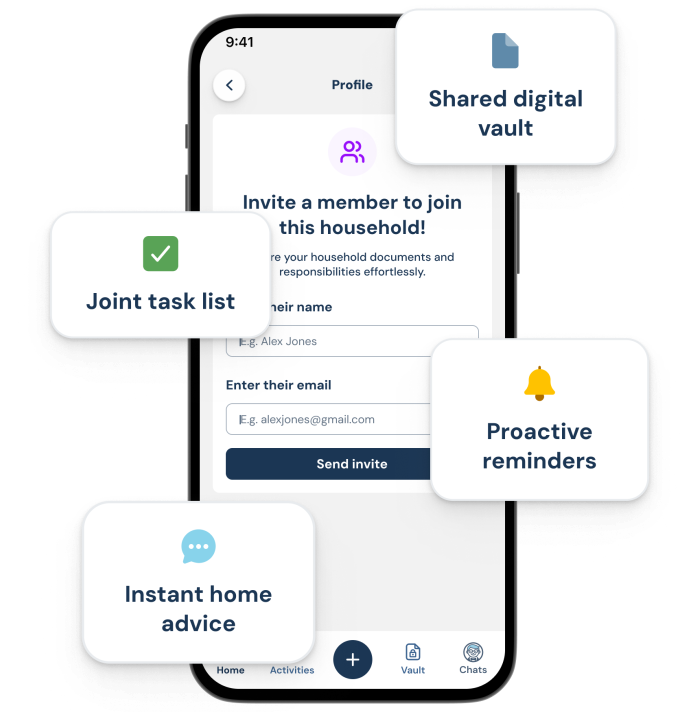
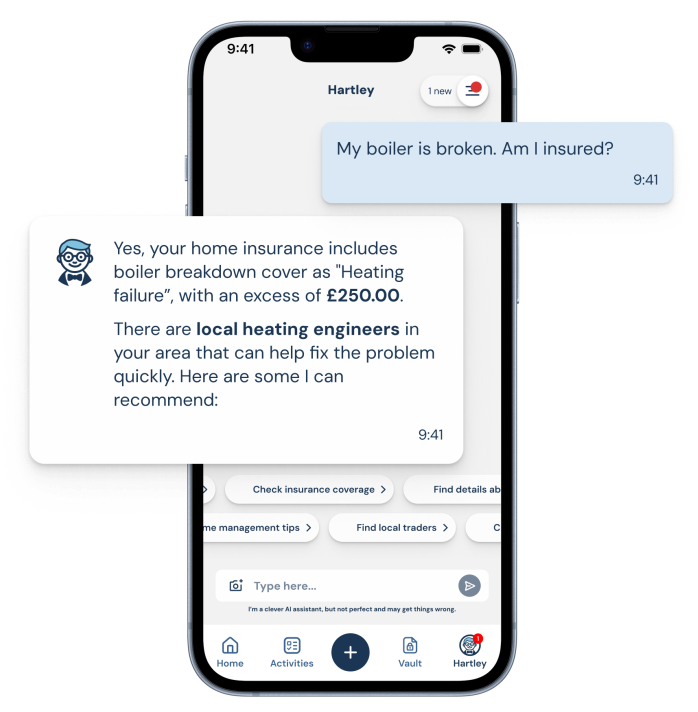
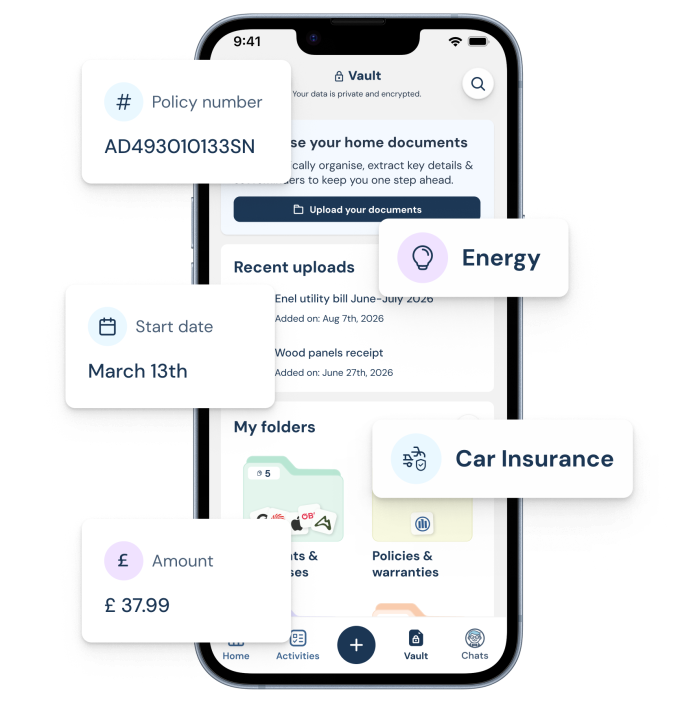
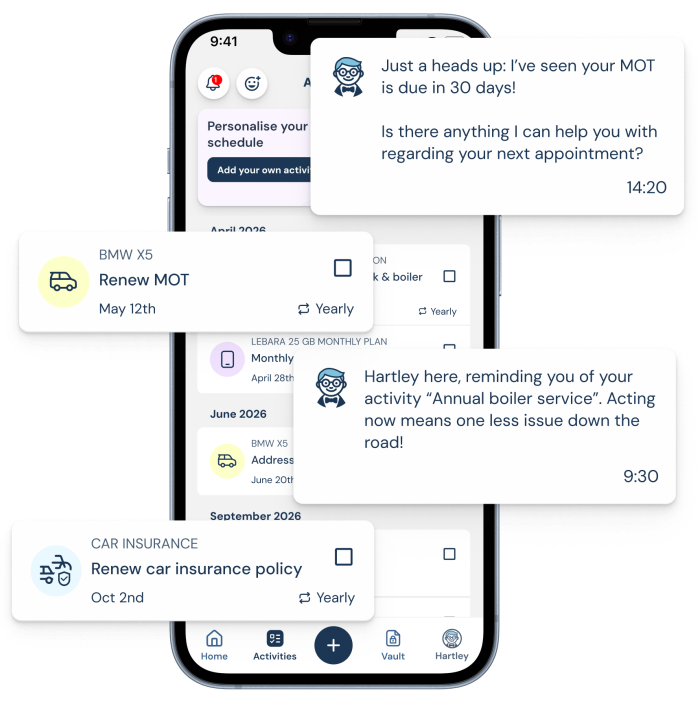
Hartley is a free household management app built to take the mental load off homeowners, renters and families. Instead of digging through inboxes and drawers for insurance documents, warranty paperwork and service records, Hartley gives every household one shared, secure place to keep it all and a proactive assistant that keeps track of it for them. Users upload a document once, then Hartley reads it, files it, and reminds them before an MOT, insurance policy or subscription is due to lapse. When something goes wrong around the house, they can describe or even take a picture of it and get instant, practical guidance on what to do next, including access to vetted local tradespeople.
Hartley Technology Limited is based in Reading, UK. Merapar has been its build partner since the very first line of code — designing, engineering and launching the product from concept through to public release.

The challenge: building trust into an AI-first product from day one
Hartley’s ambition was bold: replace the mental load of household admin with a single app that people could trust with some of their most sensitive documents: insurance policies, property deeds, warranties, etc. That meant that Merapar was being asked to build not just a mobile app but an entire product, from proof of concept through to production, on a compressed timeline and with a very high bar for security to gain user trust.
The core product question wasn’t just “Can AI read and organise this information?” It was “Will people let it?” Before committing to a full build, Hartley and Merapar needed real evidence of how comfortable households actually are with AI reading and storing private home documents, and what they would expect an assistant like this to do for them in return.
The solution: an end-to-end build, from proof of concept to an AI-powered app on AWS
Merapar took ownership of the entire journey in four phases, covering proof of concept, product direction, design, engineering, backend and launch:
1. Concept & proof of concept (April – August 2025)
Merapar validated Hartley’s core concept with a working proof of concept, testing feasibility before committing to a full product build.
2. Product direction & build (through to February 2026 launch)
Rather than guess at trust and privacy expectations, Merapar ran direct user research into how comfortable people are with an AI reading and storing private household documents, and what households actually need from an assistant like Hartley. Those findings shaped the product roadmap and design decisions before a single production feature was built, grounding the app in real user comfort levels rather than assumptions.
3. Launch, beta & iteration (from February 2026)
Hartley launched to beta users on iOS and Android, with Merapar using real usage data to refine the product in fast iteration cycles. True to how Merapar builds every AI-native product, Claude Code is embedded directly in the day-to-day engineering workflow, accelerating the routine work of shipping and iterating so the team can focus on the decisions only humans should make: product direction, security review and quality control, running experiments quicker to make better, more informed product decisions before anything goes live.
Inside the app itself, Hartley’s in-app chat assistant and the document understanding behind the household vault run on Google Gemini models via Vertex AI, built as a multi-agent workflow (LangGraph) so the assistant can reason through multi-step requests rather than just answer single prompts. A semantic “household memory”, the ability to recall what it already knows about a home, combines Amazon Titan text embeddings with Amazon S3 Vectors for retrieval inside chat.
Behind the scenes, Claude does something most AI product stories don’t: it runs operations, not just conversation. Claude Opus and Claude Haiku, via Amazon Bedrock, power an autonomous production-triage agent that classifies live incidents, investigates root causes and raises deduplicated tickets without human intervention, plus an agentic operations assistant that answers engineering questions directly against production data through a read-only tool-use loop.
This pairing — Gemini for the consumer experience and Claude for autonomous operations — reflects how Merapar builds: testing and optimising continually across models and providers, and swapping in whichever performs best for a given job as the AI landscape evolves. The specific models and versions in production today will change over time; the architecture is deliberately built to make that easy.
The wider platform is fully serverless on AWS and defined end-to-end in AWS CDK (TypeScript): Lambda APIs behind API Gateway (HTTP and WebSocket, for streaming chat), DynamoDB datastores, Step Functions document pipelines, SQS and EventBridge Scheduler for per-household reminders, Cognito authentication, SES-based email ingestion, and S3 with CloudFront for delivery. Every feature branch is deployed by Bitbucket Pipelines as a complete, disposable environment and an automated evaluation harness replays test scenarios against every change to protect agent quality, alongside independent verification at Tier 2 under Google’s App Defense Alliance CASA framework, reviewed by DEKRA.
4. Growth & monetisation (from August 2026)
With the app live and iterating on real user feedback, Hartley is moving into its growth phase, activating a commission-based revenue model that connects users to a network of vetted tradespeople directly through the app.
The results
Hartley went from proof of concept to a live, AI-powered app on the App Store and Google Play in under eight months, with Merapar delivering the full stack — product, design, AWS backend and in-app AI features — as a single build partner.
Merapar hasn’t just built our product, they’ve helped us shape our vision. They bring genuine technical depth alongside a constant eye on where AI is heading, and the judgement to translate that into features that actually matter to our users. An invaluable partner from day one.
Related
 Case
CaseMerapar helps HNR launch its HNR to Zero platform
Merapar helped HNR make its carbon accounting platform, HNR to Zero, a market-ready serverless product on AWS, launched under budget with a broader scope.
Read the case Podcast
Episode 8: Legacy Modernization: The Snooze Button You Can’t Afford
Why media and entertainment companies (and others) can’t afford to sit still on their legacy systems.
About the episode Blog
BlogPure serverless machine learning inference with AWS Lambda and Layers
Running scikit-learn inference purely on AWS Lambda, with the model in its own layer, and how the cost compares with a permanently hosted SageMaker endpoint.
Read the post
Could we do the same for you?
Tell us what you are trying to build, and we will tell you how we would approach it.